
Last week one of the suggested tasks was to:
Choose an artist totem. It might be a doll, a stuffed animal, a carved figurine, or a wind-up toy. The point is to choose something you immediately feel a protective fondness toward. Give your totem a place of honor and then honor it by not beating up on your artist child.
Let me get clinical here for a moment. I have long understood that
adults who were sexually abused as children feel an immense sense of
shame; are intolerant of vulnerability, which means just that:
vulnerable to abuse; and so have difficulty accepting the
child-in-themselves who was so abused. I know this. I’ve worked with
many clients on these issues, and worked on my own. But this
intertwining of creativity and childhood is a new tangle for me – or a
new level of tangle, which I plan to talk about in another post.
For the moment, let me just say that these issues interfere with my
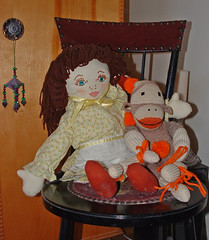
enjoyment of some of these tasks. I chose, reasonably, the above doll
for my artist totem. This was made for me by a lost friend (where are
you, Tracey Perry?) as a representative of my child self. The doll has
been on a shelf for many years; I take her out for this, and put her on
the chair my mother gave me, with the sock monkey from my childhood. Or
one I bought to replace that one; I no longer remember which.
So now all I have to do is be kind. To myself.
Not a small order.
Cameron says:
FEAR
Blocked artists are not lazy. They are blocked.
.
. . The blocked artist typically expends a great deal of energy — just
not visibly. The blocked artist spends energy on self-hatred, on
regret, on grief, and on jealousy. The blocked artist spends energy on
self-doubt.Fear is the true name for what ails the blocked
artist. It may be fear of failure or fear of success. Most frequently,
it is fear of abandonment. This fear has roots in childhood reality. .
.. . . any act of art entail[s] the risk of separation and the loss of loved ones. . .
Do not call procrastination laziness. Call it fear.
Fear
is what blocks an artist. The fear of not being good enough. The fear
of not finishing. The fear of failure and of success. The fear of
beginning at all. There is only one cure for fear. That cure is love.Use love for your artist to cure its fear.
Stop yelling at yourself. Be nice.
I am so much better about this, in so many ways.
I have so far to go.
In looking back through old journals, I find this:
2/13/92 . . . I must
record what Judd told me: "I’ve never known anyone who deserves more
respect than you do, for what you have done already with your life, and
for your mind. And I’ve never met anyone who has less respect for
themselves than you do . . ." He was so sad for me…
It’s time, I think, for me to be sad for me. So sad I do not let it continue.
Cameron again:
ENTHUSIASM
.
. . being an artist requires enthusiasm more than discipline.
Enthusiasm is not an emotional state. It is a spiritual commitment, a
loving surrender to our creative process, a loving recognition of all
the creativity around us.. . . In order to work well, many artists find that their work spaces are best dealt with as play spaces.
Dinosaur
murals, toys from the five-and-dime, tiny miniature Christmas lights,
papier–mache monsters, hanging crystals, a sprig of flowers, a fish
tank . . .As attractive as the idea of a pristine cell,
monastic in its severity, is to our romanticized notion of being a real
artist, the workable truth may be somewhat messier than that. Most
little kids would be bored silly in a stark, barren room. Our artist
child is no exception.Remember that art is a process. The process is supposed to be fun . . . At the heart of this play is the mystery of joy.
Synchronicity! — Brain death by dull cubicle — This one, actually, is a natural for me. Linda Hogan once told me that every room in my house is an altar, and this is true. Everywhere, totems and amulets, art and toys. I’ve often felt sad for people who don’t decorate their space at all, or decorate by the rules. How … well, sad.
And I recommend dogs, or cats, for those of you who have a hard time playing. They will remind you.
Cameron:
CREATIVE U-TURNS
A successful creative career is always built on successful creative failures.
Once
we admit the need for help, the help arrives. The ego always wants to
claim self-sufficiency. It would rather pose as a creative loner than
ask for help. Ask anyway.
And this — this — has less to do, for me, with my creative life than
my life in general. To ask for help — well, it implies vulnerability,
doesn’t it?

Leave a Reply